



Plan for Graduate School
Find a professor, write a research proposal and prepare thoroughly for graduate school entrance exams
Graduate school exam system is rather different from other countries, so we recommend you to understand this before preparation.Starting with finding a professor you would like to study under, and then creating a research proposal, each student requires a completely different preparation, TLS’s graduate school guidance is mainly a one-on-one style.


Graduate schools are the place to grow incipient researchers. Each laboratory seeks people who have challenge sprit and can develop the research and raise the academic level of the laboratory or university, and share the issues as a team related to the history of research conducted mainly by professors.
Schools expect to students for the high level of expertise, the ability to make logical statements in discussions and presentations, and the ability to write logical documents. Based on that abilities, to continue research with team mates and aim to contribute to society.

Very the first thing to be taken care of is finding a laboratory / professor who can realize your research. No matter how great a university or a great professor, it is not possible to enter the university because no one can instruct on the research students are aiming for.
Once the professor is found, the next step is contacting them. At that time, it is needed to follow the rules of each school, such as visiting open campus, school guidance, or contacting through the Academic Affairs Division.
Make sure that it is a place where you can deepen your research, and start preparing for the application.

The research proposal is the most important in graduate school application. The research proposals, unlike the reason for application, have to be objective and theoretical, based on analysis and consideration with the reasonable numbers and data. Each university set the format, so the proposal needs to be matched to them.
The graduates who have passed so far have subjects during their undergraduate years, and they are choosing to study in Japan in order to solve those subjects. It is not realistic solution just having feeling of what to study to pass the exam.

To ensure that all students do not miss a single step, Toyo Language School offers elective classes exclusively for students wishing to apply for graduate school.
| Warming up to prepare for graduate school |
|---|
| Consider the purpose of going on to graduate school |
| System of Japanese graduate school entrance examination |
| Make a resume |
| Research proposal(Structure・Style・Representation) |
| Consider the research subject |
| Confirm the research contents |
|---|
| Make an exam plan |
| How to write emails to professors |
| Write a research purpose |
| Research motivation / background content and structure |
| How to write application forms |
| Presentation for passing the exam |
|---|
| How to speak to professors |
| How to quote |
| How to make a bibliography |
| Consider research methods |
| Oral exam preparation |
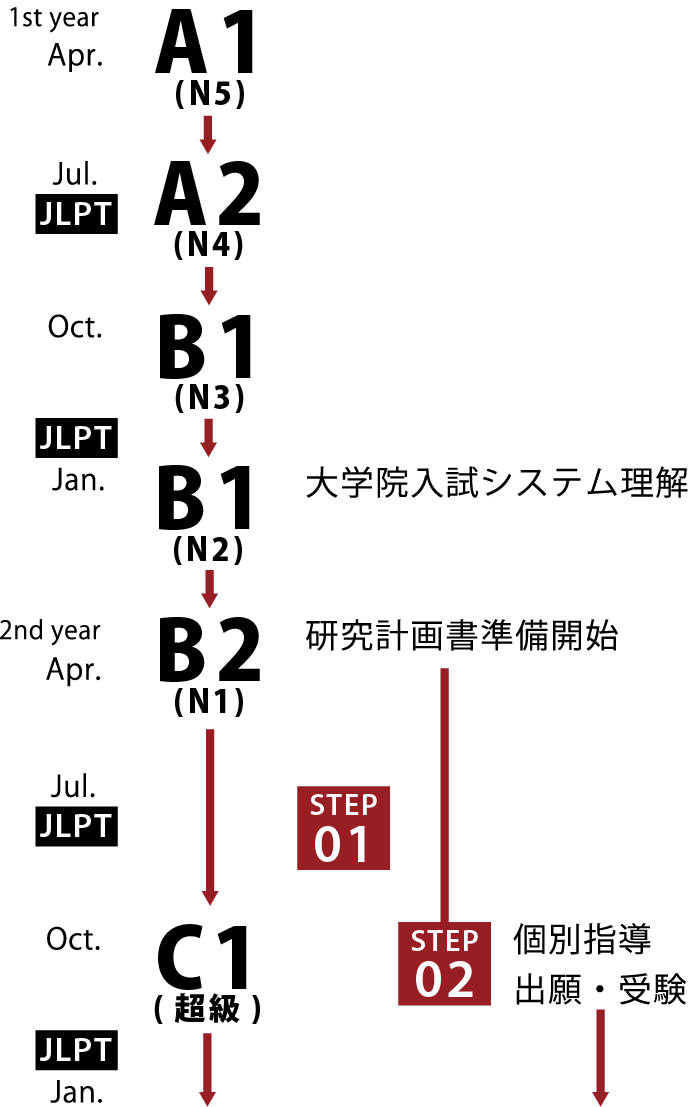
Model schedule for going to graduate school
JLPT N1 level may be set as one of the application conditions for graduate school examinations. It means, it is necessary to calculate back and proceed with learning Japanese so that students can pass N1 according to the timing of application (spring admission, fall admission).
On the other hand, they need to find a university laboratory where they can realize the research, and keep the schedule of open campuses and school guidance held by each university firmly. Preparing a research proposal, confirming the possibility of receiving instruction, and advice on improvement, etc., and preparing for this exam are the keys for going to graduate school.
The following schedule is a model for spring admission.
VOICE

Mr. Xiao Yuchuan
From China
Graduated in March 2026
Admitted to the Master’s Program in Biological Sciences, Graduate School of Science,
The University of Tokyo
Although I had passed the JLPT N1 before coming to Japan, I still felt uncertain about communicating naturally with Japanese people. Through my studies and interactions at TLS, my ability to express my thoughts in Japanese improved significantly, and I gained confidence in communicating with native speakers. Furthermore, during the graduate school entrance interview, I was able to clearly convey my ideas and my passion for research, which led to my acceptance into the Graduate School of Science at The University of Tokyo. Currently, I am conducting research in plant science at the graduate school. The Japanese language and communication skills I acquired at TLS continue to be a great asset in my research life today.
Results of JLPTCHECKTLS graduates study atCHECKAdmissionCHECK